Siedel Test

A 42 years old male, presents to the ED 1 hour after he was hammering a nail onto a wooden shelf, where the nail flew and strike his left open eye. In an attempt to help, his friend immediately removed the nail. After that, he has been having severe sharp pain and blurry vision in his left eye. On examination, the left eye had poor visual acuity, and he could only perceive light and movement. The pupil was fixed, dilated and non-reactive to light. Right eye examination was normal.

819.2 - eye penetran trauma 2 -siedel sign
819.1 - eye penetran trauma 1

How would you approach to this patient?

To learn more about it, read chapters below.

Read "Eye Trauma" Chapter

Read "Red Eye" Chapter

Quick Read

Globe rupture

It is an ophthalmologic emergency, consisting of a full-thickness injury in the cornea or sclera caused by penetrating or blunt trauma. Anterior rupture is usually observed, as this is the region where the sclera is the thinnest. Posterior rupture is rare and difficult to diagnose. It can be diagnosed through indirect findings such as contraction in the anterior chamber and decrease in intraocular pressure (IOP) in the affected eye. If there is a risk of globe rupture, a slit lamp test with 10% fluorescein must be conducted. Normal tissue is dark orange under a blue cobalt filter; a lighter color is observed in the damaged zone due to a lower dye concentration. Ultrasonography (USG) can be useful in making a diagnosis, especially with posterior ruptures. Computed tomography (CT) sensitivity ranges 56–75%. In cases of anterior globe injuries, USG use, and if there is a risk of a foreign metal body, magnetic resonance imaging, are contraindicated. Prompt ophthalmology consultation is required. While in the emergency department, tetanus prophylaxis, analgesics, bed rest, head elevation, and systemic antibiotic therapy are required. The most commonly preferred antibiotics are cefazolin and vancomycin. Age over 60 years; injury sustained by assault, on the street/highway, during a fall, or by gunshot; and posterior injuries are indications of a poor prognosis.

Siedel test

Seidel test is used to detect ocular leaks from the globe following injury. If there is penetration to the eye, aqueous leakage happens. However, the fluid is clear and hard to identify. Therefore, non-invasive test “Siedel” is used for better visualization of this leakage. Fluorescein 10% is applied to the injured eye, and the leakage becomes more prominent.

To learn more about it, read chapters below.

Read "Eye Trauma" Chapter

Read "Red Eye" Chapter

Open fracture! Antibiotic choice.

ERic Motorcycle accident

A 20-year-old male presents to your ED with a 5 cm wound after he fell off his motorbike. On physical exam, the wound overlays a fractured left tibia but does not show extensive soft tissue damage nor any signs of periosteal stripping or vascular injury. 

Which antibiotic should you give to this patient?

To learn more about it, read chapters below.

Read "Scores" Chapter
Read "Lower Extremity Injuries" Chapter

Quick Read

Gustilo-Anderson Classification

Gustilo-Anderson classification is used for fractures with open wounds and antibiotic coverage.

Gustilo-Anderson Classification

TypeDefinition
Type IOpen fracture, clean wound, wound <1cm in length
Type IIOpen fracture, wound >1cm in length without extensive soft tissue damage, flaps, avulsions
Type IIIOpen fracture with extensive soft tissue laceration, damage, or loss or an open segmental fracture. This type also includes open fractures caused by farm injuries, fractures requiring vascular repair, or fractures that have been open for 8 hours prior to treatment.
Type III AType III fracture with adequate periosteal coverage of the fractured bone despite extensive soft tissue laceration or damage
Type III BType III fracture with extensive soft tissue loss and periosteal stripping and bone damage. Usually associated with massive contamination. It will often need further soft tissue coverage procedure (i.e. free or rotational flap).
Type III CType III fracture associated with arterial injury requiring repair, irrespective of degree of soft tissue injury

According to the above classification, each class should receive the following antibiotics:

  • Type I: 1st generation cephalosporin
  • Type II: 1st generation Cephalosporin +/- Gentamycin
  • Type III: 1st generation Cephalosporin + Gentamycin +/- Penicillin

To learn more about it, read chapters below.

Read "Scores" Chapter
Read "Lower Extremity Injuries" Chapter

Eye Trauma chapter was added into the content list.

Depressed skull fracture

735.1i - head trauma - skull fracture
735.2 - head trauma - skull fracture 2

A 31-year-old male presented to the ER after falling from a 3-meter wall. He fell on his face and is complaining of face pain and body aches. He isn’t sure if he lost consciousness. GCS 15/15. Not much history was taken from the patient as he was in excruciating pain. Vitals HR: 105 bpm, RR: 19 bpm, BP: 106/59, Ox. Sat: 100%, Temp: 36.9.

This case is a kind of unusual. Having this amount of depression of the skull and showing almost no neurological abnormality is not happening very frequent.

We hope that you also recognized the air inside in the right image.

To learn more about how to read the CT scan, see the chapter below.

How to read head CT by Reza Akhavan

You may also see below infographic showing a mnemonic about reading head CT in the ED.

Seat Belt Sign

722.1 - seat belt sign 1

A 32 years old male was involved in an MVC where he was in the front seat as a passenger and had his seatbelt on. It was a direct front collision. The patient is stable. He is in moderate pain. Displacement of the lower part of the sternum as well as a retrosternal hematoma was noted after the ED care.

Trauma care is very important as globally recognized. It is also important to prevent injury. Seat belts are doing their part to prevent further injury. However, they may not be protective, or even cause injury if the other prevention measures were not applied such as speed limit.

This case shows dramatic skin lesions caused by the seatbelt. You can see various images of this in the clinical image archive (just click the image). What seatbelt sign says to us? INVESTIGATE FURTHER INNER INJURY… This patient has neck, chest, abdomen skin findings. Therefore, vascular injuries (aorta, vein), viscus injuries (perforation, bleeding), solid organ lacerations (spleen, liver, pancreas), contusions (cardiac) in the neck, chest, and abdomen should be investigated.

To learn more about trauma management read below chapter.

Multiple Trauma by Pia Jerot and Gregor Prosen by Dan O’Brien

A baby with burn!

711 - 2nd degree burn-2

11-month-old baby presented to the ED with a burn after accidental hot tea slippage over her.

Burn is a complicated injury for many reasons. It is severely painful, creates the risk of infection, potential volume loss may create further injuries in vital organs. Although these clinical problems are very important and should be managed appropriately, there is one thing we need to consider while we face with any child with a burn. This is child abuse or neglect. As a young physician, it is better to know and be familiar with this issue now because if you do not know it, you can not suspect it. We will have a post soon about the child abuse and neglect hints.

To learn about burn management, please read below chapter.

Burns by Rahul Goswami

How to stop bleeding!

712 - deep fore arm laceration

A 22-year-old male, aluminum factory worker, was brought by his friend to the ED after he accidentally fell on a sharp glass, 30 minutes ago. The patient presented with moderate bleeding from lacerations in his forearm. He was feeling dizzy and in severe pain.
Co-Morbid Conditions: None
Hand dominance: right-handed
Occupation: Aluminum factory worker
Denies smoking and use of the illicit drug
Last tetanus booster: unknown
Temperature oral: 36.7 C
Peripheral pulse rate: 91 bpm, regular
Respiratory rate: 17 bpm
Blood pressure: 164/75 mmHg
Oxygen saturation, on room air: 100%
GSC: 15/15

This is a deep laceration. Bleeding is one of the critical problems here. Because blood loss is a deadly situation, even with a simple laceration, we should concern about vascular injury. However, in the ED, our role is not the finding the actual problem in the early moments. Our role is to stop the bleeding immediately with some simple maneuvers or applications. Of course, this case should be evaluated for foreign body (direct visualization, x-ray, US may help), tendon and muscle injuries as well as nerve injuries. But, bleeding control is the first priority.

To learn about management, please read the chapter below.

Basics of Bleeding Control by Ana Spehonja and Gregor Prosen

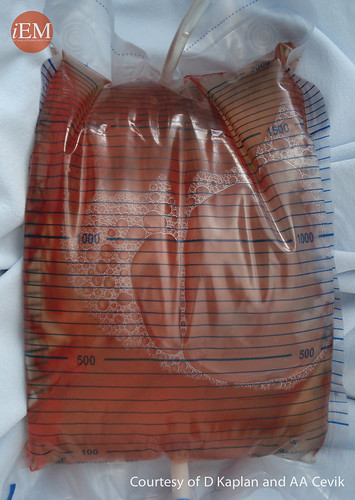
Red urine

684.1 - electrical injury - rhabdomyolysis

In case you didn’t encounter a construction worker who presented with high voltage electrical injury today!

683.4 - electrical burn entry

iEM Education Project Team uploads many clinical picture and videos to the Flickr and YouTube. These images are free to use in education. You can also support this global EM education initiative by providing your resources. Sharing is caring!

From Experts To Our Students! – Burn Injuries

rahul goswami - burns

Burns chapter written by Rahul Goswami from Singapore is just uploaded to the Website!

From Experts To Our Students! – Clinical Decision Tools

Clinical Decision Rules chapter written by Stacey Chamberlain from USA is just uploaded to the Website!

What is the name of this fracture?

In case you didn’t encounter a trauma patient today!

674.4 - C1 fx

iEM Education Project Team uploads many clinical picture and videos to the Flickr and YouTube. These images are free to use in education. You can also support this global EM education initiative by providing your resources. Sharing is caring!

From experts to our students! – Splinting